
Your AC quits at 9 PM on a Saturday. Or the furnace goes quiet at 11 on a Tuesday night. The house is already getting uncomfortable, the kids are asking questions, and you’re staring at your phone trying to decide: do I call someone right now, or can this wait until morning?
We get this exact scenario all the time. And honestly, the answer isn’t always “call us immediately.” Sometimes the smartest move is to wait. Sometimes it absolutely isn’t. The hard part is knowing which is which when you’re tired, hot (or cold), and a little stressed.
So let’s walk through it the way we’d talk you through it on the phone.
Start Here: Is Anyone in Danger?
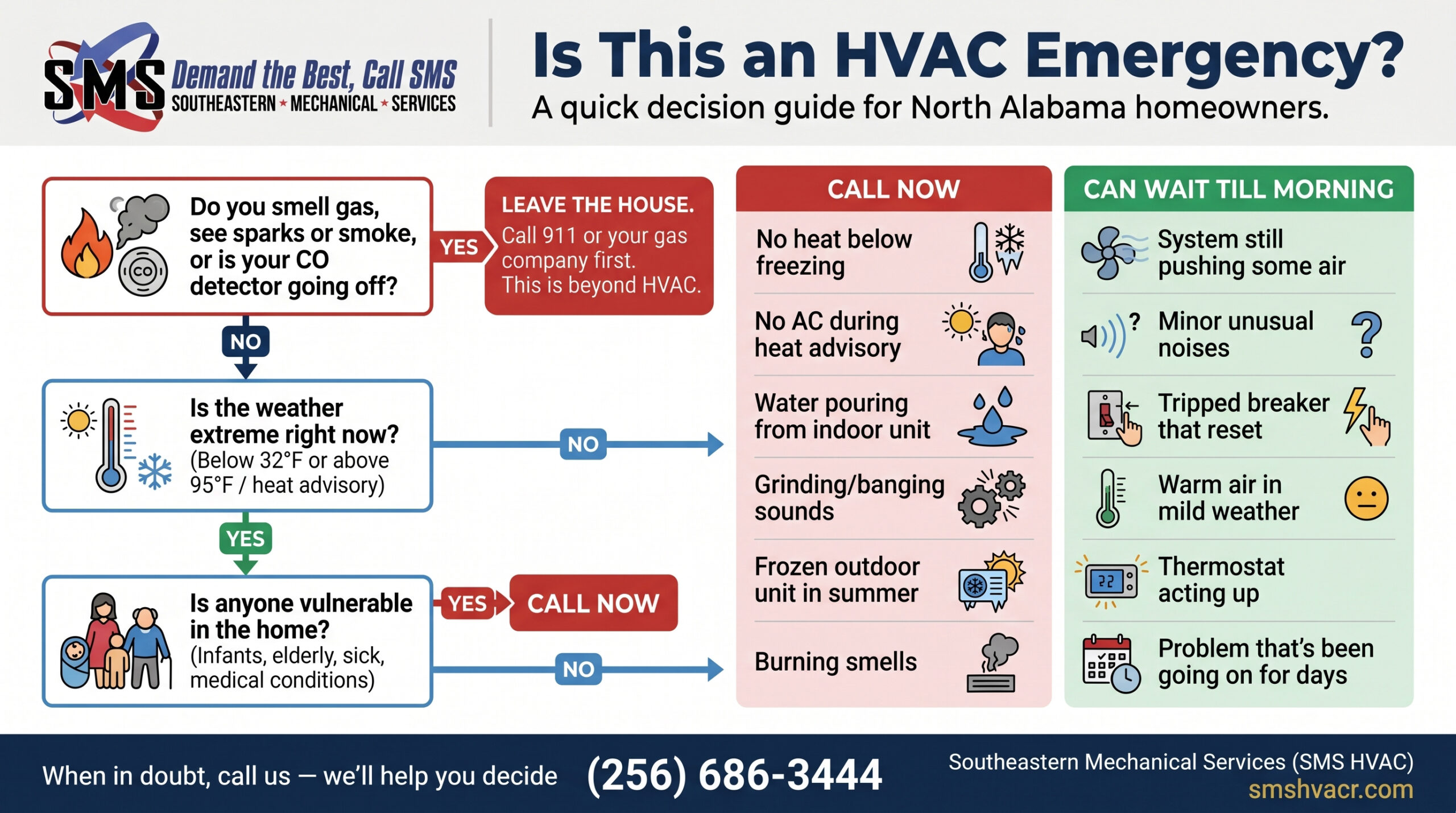
Before you think about comfort, think about safety. Some situations are not HVAC problems. They are emergencies that require you to leave the house and call someone other than us first.
If you smell rotten eggs or gas of any kind, get everyone out of the house and call your gas company from outside. Don’t flip any switches. Don’t start a car in the garage. Just leave. Once everyone’s safe, then call us about the HVAC side of things.
If you see sparks, smell burning plastic, or see smoke coming from your unit or electrical panel, cut power to the system at the breaker and call the fire department if you see flames or smoke that’s not clearing. Electrical fires don’t wait politely.
If your carbon monoxide detector is going off, get out of the house and call 911. This is especially a concern with gas furnaces. Don’t try to figure out if it’s a false alarm while standing inside.
These situations are rare, but they’re the ones where seconds matter. Everything else on this page is about comfort and equipment, not safety.
The Two-Question Triage
Once you’ve confirmed nobody is in danger, almost every HVAC problem boils down to two questions:
- How extreme is the weather right now?
- Is anyone in the house especially vulnerable to that weather?
If it’s 72 degrees outside and your AC is acting up in April, that’s not an emergency. Open some windows, shut it down, and call us in the morning. If it’s 98 degrees in July with a heat advisory and your AC quit, that’s a different conversation. Same logic in winter. A chilly night in October with the heat out? Annoying but survivable with blankets. A 20-degree January night with the heat out and a newborn in the house? Different story.
Here’s how we think about the vulnerability piece. Call us right away if any of these apply:
- Infants or very young children in the home
- Elderly family members, especially anyone with heart or breathing conditions
- Someone in the house who’s sick, recovering from surgery, or has a chronic medical condition
- Pets that can’t regulate their temperature well (brachycephalic dog breeds, older animals, etc.)
- Temperatures that are dangerous on their own, regardless of who’s home
If none of those apply and the weather isn’t extreme, you’ve usually got room to wait.
Signs It’s a Real Emergency (Call Now)
Some symptoms point to problems that actually get worse the longer you wait. If you’re seeing any of these, don’t tough it out until morning:
- No heat when it’s below freezing outside. Pipes can freeze, and that’s a much more expensive problem than an HVAC repair.
- No AC during an active heat advisory. Heat-related illness is real, especially for older adults and kids.
- Water pouring out of your indoor unit. This isn’t just a comfort issue anymore. It’s a potential flooring, drywall, and mold problem that’s actively getting worse by the minute.
- Grinding, banging, or metal-on-metal sounds when the system tries to run. Something’s broken loose, and continuing to run the system will usually turn a medium repair into a major one.
- The outdoor unit is frozen solid in the middle of summer. That means refrigerant issues or airflow problems, and running it in that condition can damage the compressor. Shut it off and call.
- Burning smells (not the “first time running the heat this season” dust smell, but an actual acrid burning odor).
- Complete loss of heating or cooling in extreme weather with vulnerable people home.
Signs It Can Probably Wait Until Morning
These are the cases where calling us at 2 AM doesn’t really help you — the repair will be the same repair eight hours later, and it’ll cost you less:
- The system is still putting out some conditioned air, just not as much as usual
- Weird noises that started recently but the system still runs
- A tripped breaker that reset and hasn’t tripped again
- Warm air coming from the vents when the AC is running, but outside temps are mild
- A thermostat that’s acting up but the system itself seems fine
- You notice a problem at night that’s been going on for days
For any of these, the smart play is to turn the system off, ride it out, and call first thing in the morning. You’ll get faster service, you won’t pay an after-hours fee, and you won’t end up paying inflated rates if we need to grab a part from a supplier who charges extra to open after hours.
Why We’re Honest About This
Here’s the thing. We’re a 24/7 emergency HVAC company. You’d think we’d want every call to come in at midnight. But we don’t.
After-hours calls are expensive for the homeowner. Our emergency service fee is higher than a daytime call because we’re paying technicians overtime and keeping someone on rotation every night of the year. And if we need a part that we don’t carry on the truck, supply houses around here charge significant fees — often $150 to $225 — just to unlock the doors for us after hours. Those costs end up on your bill.
When the situation is genuinely urgent, every penny of that is worth it. When the situation can wait, we’d rather you save the money and sleep in your own bed. Our business does better long-term when customers feel like we helped them make the right call, not when we squeezed every dollar out of a stressful situation.
How Our After-Hours Line Actually Works
If you do decide to call after hours, here’s what happens. The phone rings through to a professional answering service — a real human, never a recording. They’ll ask you about the problem to make sure it’s something that can’t wait, and they’ll get your agreement on the emergency service fee before anything else happens. Then one of our technicians calls you back directly to talk through the situation and figure out next steps.
That first conversation with the technician is important. A lot of times we can walk you through something over the phone and either get the system running again or confirm that yes, we need to come out. Either way, you’re not charged for that phone conversation.
For the full breakdown of how we handle emergency service calls, pricing, and what to expect, head over to our Emergency HVAC Service page.
Save Our Number Before You Need It
The best time to program our number into your phone is right now, not at 11 PM when your AC just died and you’re fumbling to find a contractor you trust. Save it under something you’ll remember: SMS HVAC — (256) 686-3444.
We’re here around the clock when you need us, and we’re just as happy to tell you “that can wait until morning, here’s what to do in the meantime” as we are to send a truck. Either way, you’re not on your own.