
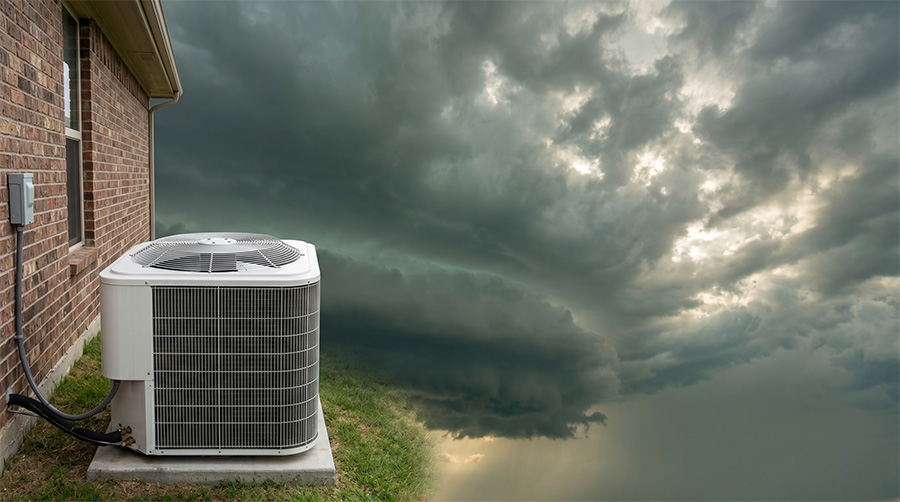
The sirens go off. The weather app on your phone makes that tone you know instantly. You move the family to the interior room with no windows, the dog comes with you, and you wait. Twenty minutes later it’s quiet, the warning expires, and you walk back through the house to look out at the yard. Your outdoor AC unit is sitting where it always sits. Or maybe it isn’t.
At Southeastern Mechanical Services, we get a wave of calls in the days after every major storm system that rolls through North Alabama. Some homeowners have obvious damage. Most don’t. But almost everyone has the same question: is my system safe to turn back on, or did that storm hurt something I can’t see?
The honest answer is that most systems come through most storms just fine. The other honest answer is that a little preparation beforehand, and a careful approach afterward, will catch the problems that aren’t immediately obvious. Let’s walk through what actually matters.
Why Tornado Season Hits HVAC Systems Hard Around Here
North Alabama sits right inside what storm researchers call Dixie Alley. The National Weather Service office in Huntsville covers some of the most active severe weather territory in the country, and the data tells the story. Our primary tornado season runs March through May, with a smaller second peak in November. The Tennessee Valley terrain, the moisture coming up from the Gulf, and the spring temperature contrasts all combine to make this region one of the more active in the U.S. for damaging storms.
A direct tornado hit on your house is going to damage your HVAC system along with everything else, and that’s an insurance conversation. But that’s not actually what we deal with most. What we deal with most is the storms that pass nearby without directly hitting you. The straight-line winds, the hail, the lightning surges, the power outages. These are the events that quietly damage HVAC systems across Decatur, Athens, Hartselle, and surrounding communities every spring without making the news.
Straight-Line Winds Are More Common Than Tornadoes
What meteorologists call damaging downbursts regularly hit 60 to 80 mph in our region during severe storms. That’s enough to send a patio chair into your condenser, lift a section of metal flashing off an outbuilding and slam it into the side of your outdoor unit, or knock a tree limb onto the equipment.
Hail Is the Silent Killer
We see hail damage on outdoor units almost every spring, and homeowners often don’t catch it because the system still runs. Bent condenser fins reduce airflow across the coil, which forces the system to work harder, which kills efficiency, which raises your electric bill. The damage is real even when the symptoms aren’t dramatic, and insurance often covers it if you catch it early.
Lightning Surges Take Out More Equipment Than Direct Strikes
A direct lightning strike on your house is rare. A nearby strike that sends a voltage spike through the power lines is common. Modern HVAC systems are full of electronic control boards, sensors, and communication modules. Every one of those components can be destroyed in microseconds by a surge that never touched your roof.
Before the Storm: Smart Prep That Pays Off
You can’t tornado-proof your AC. But a few simple steps significantly reduce the odds of major damage and make any insurance claim much smoother.
Clear the Area Around Your Outdoor Unit
Walk around your condenser. Look at what’s within twenty feet. The patio chair you keep meaning to move. The trash cans on the side of the house. The pile of firewood from last winter. The trampoline in the neighbor’s yard.
In a 70-mph wind, all of these become projectiles aimed at your AC. You don’t need to clear the yard. Just identify the heavy or sharp objects close to the unit and move what you reasonably can. Trim tree limbs that hang directly over the unit before storm season really gets going.
Add a Whole-House Surge Protector
A whole-house surge protector installed at your electrical panel costs a few hundred dollars and protects every electronic device in your house, including your HVAC system. The Insurance Institute for Business & Home Safety consistently lists surge damage as one of the most common storm-related claims.
If you’ve never had one installed, this is genuinely one of the best small investments a North Alabama homeowner can make. We’ve replaced more lightning-damaged HVAC control boards in the Tennessee Valley than we can count, and most of those failures were preventable with a $300 surge protector.
Raise the Condenser If You’re in a Flood-Prone Spot
Some homes in Mooresville, Priceville, and lower-lying parts of Decatur deal with standing water during heavy rain events. If your outdoor unit sits low and you’ve had water near it before, ask us about a raised pad. A compressor that spends an hour underwater is usually a compressor that needs replacing.
Document Your System While Everything’s Working
Take photos of your HVAC equipment while it’s still in good shape. Clear shots of the outdoor unit from a few angles. A close-up of the data plate with the model and serial number. The same for the indoor air handler or furnace and any visible ductwork.
Store the photos somewhere outside the house. Email them to yourself. Save them to cloud storage. Send a copy to a family member. If a storm destroys the house and your phone with it, you still want the records.
This is the single most useful thing you can hand an insurance adjuster after a claim. Ready.gov recommends documenting your major systems and appliances as part of basic disaster preparedness, and HVAC equipment is usually the most expensive item nobody thinks to photograph until it’s broken.
During the Storm: What to Actually Do
When a tornado warning is issued for your area, the simplest move is to shut the system off completely. Switch the thermostat to off, then flip the breaker for the HVAC system off at your electrical panel.
This isn’t about saving energy. It’s about protecting the equipment from surges if power gets disrupted. Power flickers, momentary outages, and the eventual restoration of power after a storm are all moments where voltage spikes can damage electronics. A system that’s off and disconnected from power can’t be damaged by these spikes.
Don’t go outside to cover the unit or move things around during the storm. We’ve actually had homeowners tell us they ran out to throw a tarp over the AC during a warning and got caught in 70-mph wind gusts. Whatever damage might happen to the equipment is replaceable. You are not.
Stay in your safe place until warnings have expired and the sirens have stopped completely. Then think about HVAC.
After the Storm: Check Before You Flip the Breaker
Once it’s safe to be outside, do a walk-through before you turn anything back on.
Inspect the Outdoor Unit
Walk around it. Look for debris in the fins or on top of the unit. Check the fins for hail dents or bent sections. Make sure nothing is leaning against the side. Verify the unit is still sitting level on its pad and hasn’t shifted.
If you see hail damage, the unit usually still runs, but you’ll want to file an insurance claim while the damage is fresh. Don’t try to comb the fins back into shape with anything from the garage. That’s a job for the right tool, and we’ll bring one when we come out.
Check Around the Indoor Unit
Walk to wherever your air handler or furnace lives. Closet, attic, garage, crawlspace. Look for standing water on the floor. Check for water stains that weren’t there yesterday. Listen for unusual sounds when nothing should be running.
If you find water or dampness near the equipment, leave the breaker off and call us. Running a system with water inside it can short electrical components and turn a small problem into a much bigger one.
Smell Test for Gas
If you have gas appliances anywhere near your air handler (a gas furnace, a water heater, a gas dryer), pay attention to any unusual smells. The vibration and shaking from severe weather can occasionally loosen gas line connections. If you smell rotten eggs or gas of any kind, get out of the house and call your gas company from outside. Don’t flip switches, don’t start the system.
Then Try the System
If everything looks reasonable and you don’t smell gas, flip the breaker back on and try the system. Listen to it for the first five or ten minutes. Any new noises? Any new vibrations? Any new smells that aren’t just dust burning off?
If it starts up and runs normally with no new symptoms, you’re probably fine. Keep an eye on your energy usage over the next few weeks. A subtle inefficiency from minor hail damage can show up on your electric bill before it shows up anywhere else.
When to Call Insurance First vs. When to Call Us
This part trips up a lot of homeowners.
If the damage is obvious and significant, call your homeowners insurance first. A tree on the unit. A condenser knocked off its pad. Visible hail destruction of the fins. The claims process moves faster when you start with them, and they’ll usually send an adjuster to document the damage. We can come out and provide written repair estimates that work with the adjuster’s process.
If the damage is functional but not obviously catastrophic, call us first. The system runs but not as well. A new noise. A breaker that keeps tripping. The thermostat lost its programming. These are diagnostic situations where we can tell you whether it’s worth filing a claim or whether it’s a quick fix that doesn’t involve insurance at all.
If there’s no visible damage but the system simply won’t turn back on, also call us first. Often it’s a tripped breaker, a blown low-voltage fuse from a power surge, or a thermostat that needs to be reset. These are typically same-day fixes.
For after-hours storm emergencies, you can reach us at 256-686-3444. We’ll be honest with you on the phone about whether your situation needs us tonight or whether it can safely wait until morning.
Documentation Matters More Than People Think
Whatever happens, document everything.
Take photos of any damage from multiple angles, close-up and wide shots. Note the date and time you first noticed problems. Save broken parts somewhere safe. Don’t throw the busted fan blade in the trash before the adjuster sees it. If you have to run a portable AC unit, space heaters, or stay in a hotel while waiting on repairs, keep every receipt.
Insurance companies pay claims based on documentation. The more you have, the smoother the process goes and the less you end up arguing about.
Red Flags That Need Professional Help
After a storm, some symptoms mean you should call before running the system any further:
- Visible damage to the outdoor unit (bent fins, dented housing, shifted off its pad)
- Standing water near the indoor unit or furnace
- Any burning smell from the system after restoring power
- Breakers that trip immediately or won’t stay reset
- Grinding, rattling, or banging sounds that weren’t there before
- The system runs but doesn’t cool or heat the way it did last week
- Any smell of gas anywhere in the house
Continuing to run a damaged system can turn a moderate repair into a major one. Better to call and pay for a diagnostic than to ride it out and end up replacing a compressor or a control board you could have saved.
Get Your System Ready Before the Next Round
Storm season in North Alabama is just part of life here. Most years roll by with nothing more dramatic than a hailstorm or two. But anyone who’s lived through enough April outbreaks in the Tennessee Valley knows that being prepared beforehand is the difference between a stressful weekend and a real ordeal.
If you’d like us to give your system a pre-season check before storm activity picks up, or if your AC took a hit during recent weather and you’re not sure what to do next, give us a call at 256-686-3444 or contact us online. We serve Decatur, Athens, Hartselle, Trinity, Priceville, Somerville, Mooresville, Austinville, Cullman, and communities throughout North Alabama.
Storms will keep coming. Let’s make sure your HVAC is ready for them.