You are sitting at the kitchen table with a quote for a new air conditioner, and somewhere on the paperwork you spot a refrigerant you have never heard of. R-454B. Or maybe R-32. The system you are replacing ran on something called R-410A for the last fifteen years, and now suddenly that is gone. Is your old unit obsolete? Did the rules change overnight? Are you about to pay for something experimental?
Take a breath, because the real answer is a lot calmer than the internet makes it sound. At Southeastern Mechanical Services, we have been fielding a steady stream of these questions lately, and almost all of them trace back to a single change in the industry that affects every new air conditioner and heat pump sold in the country right now.
Here is the plain-English version: what changed, what it means for the system you already own, and what to expect if you are shopping for a new one here in North Alabama.
What Changed, and Why
The short story is that the federal government is phasing out the old refrigerant. Under the EPA’s AIM Act, manufacturers were required to stop building new residential air conditioners and heat pumps that use R-410A as of January 1, 2025. Anything built and sold new today runs on one of two newer refrigerants, R-454B or R-32.
The reason behind it is environmental. R-410A is a potent greenhouse gas, and the new refrigerants do the same job with roughly three-quarters less global warming potential. If you want the regulatory specifics, the EPA’s HFC reduction program lays them out, but the practical takeaway is simple. The industry moved on, and the equipment on dealer floors today is built around the new chemistry.
One thing worth clearing up, since the word gets tossed around loosely. This is about refrigerant, the fluid that cycles through your air conditioner and heat pump to move heat in and out of your home. It has nothing to do with your refrigerator or any kind of cold storage. Same root word, completely different machine.
Do You Need to Replace Your System Right Now?
For the large majority of homeowners, no. This is the part that gets lost in all the noise.
If your current system runs on R-410A and it is working fine, you do not need to do anything. R-410A is still completely legal to use, and a licensed technician can still service, repair, and recharge your existing system. Nobody is going to make you scrap a unit that is doing its job.
What changed is what gets manufactured going forward, not what you are allowed to keep running. We tell customers this all the time. A working system is a working system, and the smartest money is usually the one you already own, maintained well, right up until it genuinely reaches the end of its life.
What It Means for Repairs on Your Current System
Here is the honest wrinkle. Because new R-410A is no longer being produced in the same volumes, the available supply is slowly tightening. Over the next several years, that means the cost of an R-410A recharge or a refrigerant-related repair on an older system is likely to creep upward.
That does not change the math overnight, but it does nudge it. If you have a system that is ten or fifteen years old and it springs a refrigerant leak that needs a big repair, the rising cost of the old refrigerant becomes one more item on the “maybe it is time” side of the ledger. If your system is only a few years old, a repair is still just a repair, and replacing it would be premature.
When we come out for a repair like that, we will give you the straight comparison: what the fix costs, what a replacement costs, how old your system is, and how those numbers actually shake out for your situation. There is no pressure from us to replace something that has good years left in it. You can get a feel for how we handle air conditioning repair and replacement if you want a sense of our approach.
What to Expect When You Buy a New System
If you are buying new, your system arrives pre-charged with R-454B or R-32 from the factory. You do not pick the refrigerant. It is decided by whichever manufacturer built the equipment. Most major central systems use R-454B, while a lot of ductless mini-splits, including Mitsubishi, use R-32. Both are thoroughly tested, both keep your home just as comfortable through an Alabama summer as the old refrigerant did, and you will not feel any difference in the air coming out of your vents.
A few things worth knowing before you sign anything:
You cannot convert your old system. The new refrigerants run at different pressures and need different components, so there is no retrofitting an R-410A unit to run on R-454B or R-32. If a contractor ever offers to “convert” your existing system to the new refrigerant, treat that as a red flag. It is not something the manufacturers support, and you should walk away and get a second opinion.
The new systems have added safety features. R-454B and R-32 are classified as mildly flammable, which sounds scarier than it plays out in practice. New equipment is built to updated safety codes with built-in leak detection, and when it is installed correctly by a trained technician it is completely safe for your home.
The early price bump has mostly settled. When the change first rolled out there was some sticker shock as manufacturers retooled. As production scaled up across the industry, that premium has largely leveled back out, so the refrigerant change itself is not the budget-buster some early headlines suggested.
If you are leaning toward ductless, this is a spot where the brand we know best lines up nicely with the change. As a Mitsubishi Diamond Dealer, we install their ductless mini-split systems regularly, and Mitsubishi’s equipment already runs on the modern R-32 refrigerant.
Why a Trained, Licensed Installer Matters More Now
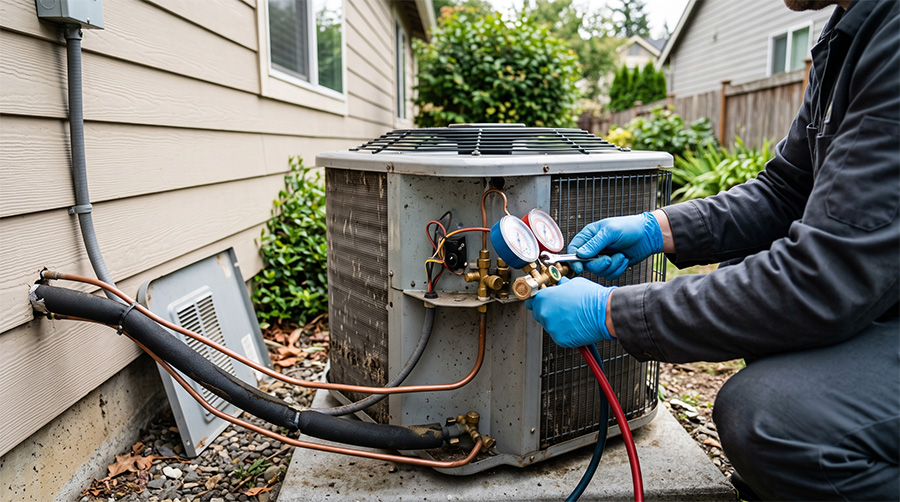
The switch raised the bar on installation and service. The new A2L refrigerants require technicians with updated training and a different set of tools, including specialized leak detection and recovery equipment. This is not a place to cut corners.
It also makes for a good question to ask any company you get a quote from: are your technicians trained to handle the new A2L refrigerants? If someone gets cagey on that answer, keep looking. Every system we install and service is handled by licensed, trained technicians, which honestly matters more today than it did even two years ago.
Keeping a New System Affordable
A new system is a real investment, and we get that. The federal 25C tax credit that used to help offset a high-efficiency upgrade expired at the end of 2025, so be cautious of anyone still advertising it as a current incentive. What is still very much available is TVA EnergyRight rebates through our local utilities, along with financing options that spread the cost into manageable payments. We are glad to walk you through what you actually qualify for before you commit to anything.
When It Is Worth Giving Us a Call
A few situations where it makes sense to have a professional take a look:
- Your system is more than ten years old and just hit a major refrigerant or compressor repair
- You are needing refrigerant recharges more than once, which usually points to a leak rather than a simple top-off
- Your energy bills are climbing and the system is not keeping up the way it used to
- You are shopping for a new system and want a straight answer on R-454B versus R-32 for your home
- A contractor offered to convert your old R-410A unit to the new refrigerant, in which case get that second opinion
If you are not sure where your system stands, an honest assessment beats guessing. You can also keep your current system healthier and stretch its remaining life with regular maintenance, which counts for even more while R-410A supplies tighten.
Whether you are nursing an older R-410A system along or you are ready to talk about a new one, we are here to give you the honest version rather than a sales pitch. Southeastern Mechanical Services keeps homes comfortable across Decatur, Athens, Hartselle, Trinity, Priceville, Somerville, Mooresville, Austinville, Cullman, and the surrounding North Alabama communities, and we are happy to help you sort out what the refrigerant change means for your home. Give us a call at 256-686-3444 or reach out for a free consultation.